

Get Smooth Bong Hits Without Coughing Every Time
You get smooth bong hits with less coughing by fixing three variables first: water level, a clean diffusion path, and a slower, cooler pull. Most harshness is not a sign you need a “smoother bong” right now. It is usually a setup miss that turns your water pipe into a hot, stale, splashy mess.
Here’s what matters most right now:
- If hits feel harsh and hot, your water level is often off for your downstem.
- If you taste stale funk, residue in stem slots and perc holes is usually the culprit.
- If you get splashback, you are likely overfilling the water chamber.
- If the pull feels like a milkshake, diffusion may be clogged or water is too high.
- If hits vary every time, your pack and flame control are probably inconsistent.
- If you add multiple cooling changes at once, you will not know what actually helped.
At SmokeToki, we focus on smooth hits because you should not have to gamble on a new piece to fix a fixable problem. Once your setup is dialed, upgrades like an ice pinch beaker bong for cooler pulls or a straight-tube bong that clears fast can make a real difference. When you are ready to shop, we also keep it low stress with free discreet shipping on orders $50+.
Start by diagnosing the exact symptom you are fighting, because each one points to a different fix you can do in under a minute.
Up next is the 60-second smooth-hit checklist that maps what you feel to what to change.
The 60-second smooth-hit checklist: symptom to fix
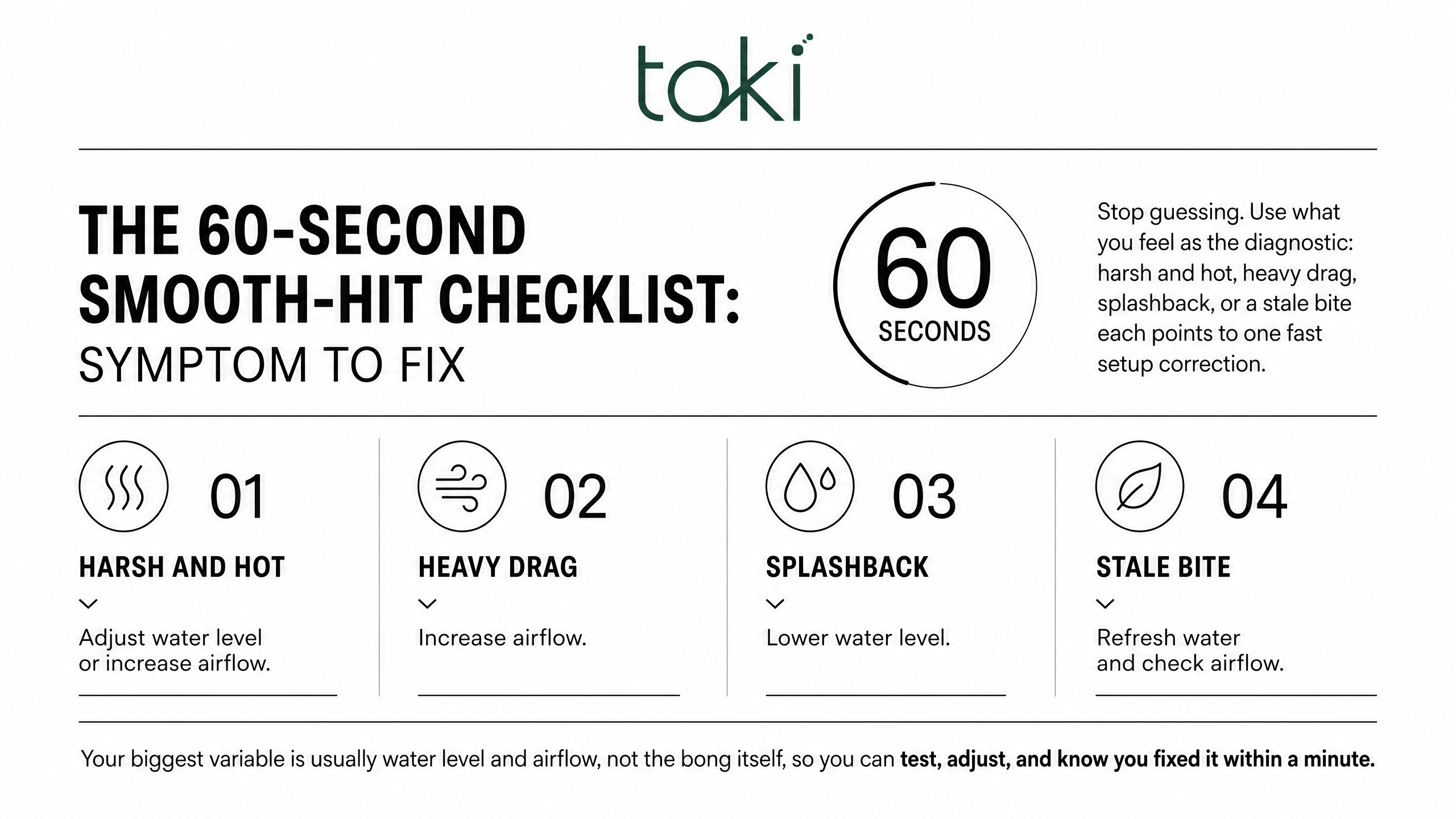
Stop guessing. Use what you feel as the diagnostic: harsh and hot, heavy drag, splashback, or a stale bite each points to one fast setup correction. Your biggest variable is usually water level and airflow, not the bong itself, so you can test, adjust, and know you fixed it within a minute.
Harsh and hot hits
Harsh, hot pulls usually mean you are getting weak diffusion and too much heat too fast. The quickest win is dialing your water level and slowing your pull so the water can actually do its job.
Start with the water chamber: if the downstem barely reaches water, you lose percolation and the hit feels sharp. If the water looks cloudy or smells off, you are also pulling stale funk through the same path.
Technique and pack matter here more than people want to admit. A hard, fast rip can overwhelm the diffusion you have, and an overpacked bowl restricts airflow so the smoke gets hotter and denser before it ever hits the water.
- Water too low or dirty: fill to about 1-2 inches above the downstem tip, then do a dry test draw; change water if it is cloudy or leaves smell on the glass.
- Pull speed too aggressive: switch to a steady, controlled pull that keeps bubbles consistent, not violent; you want stable percolation, not chugging.
- Bowl packed too tight: loosen the pack so air can move through the material evenly; a tight bowl forces you to pull harder, which heats everything up.
Too much drag
When the pull feels like a blocked straw, you are fighting resistance, not “getting a stronger hit.” Drag almost always comes from a clogged diffusion path, too much water, or debris physically blocking airflow.
Check the simplest restriction first: the downstem and any perc openings. Resin buildup narrows the pathway fast, and a partially clogged perc makes you pull harder, which can also worsen harshness.
Water level can create drag too. Overfilling submerges more of the pathway than needed and forces you to push smoke through extra water pressure.
- Clogged downstem or perc: remove the downstem if you can and inspect for visible resin film; if bubbles look uneven or only come from one side, that is a clog signal.
- Water too high: lower it until you still get active bubbling but the pull feels free; you are aiming for diffusion, not maximum fill.
- Ash blocking airflow: check the bowl and stem joint for loose ash; even small bits can lodge and choke the draw.
Water in your mouth
Splashback is almost always a water level and angle problem. The fix is simple: stop overfilling, keep the piece more upright, and watch for beaker-style “surge” cues during the draw.
Overfilled chambers push water up the neck when you pull, especially if you rip hard. Angle mistakes amplify it, because tilting changes where the waterline sits relative to the downstem and the tube.
Beaker bongs have a wide base that can slosh and surge. You will often see water climbing the neck in the first second of the pull before it actually reaches your mouth, and that is your early warning to stop and lower the water.
- Overfilled chamber: dump a little water and re-test draw until bubbling stays below the neck and you do not see water rising toward your lips.
- Angle and tilt mistakes: keep the bong vertical while pulling; avoid leaning it back like a bottle, which makes splashback more likely.
- Beaker splashback cues: watch the neck during the first inhale; if you see a fast “wave” climbing upward, your water level is too high or your pull is too forceful.
Stale or harsh taste
A stale, bitter taste is usually residue plus old water, not your material. You are tasting buildup in the stem and chamber, and that layer also makes airflow less consistent.
Resin film in the downstem is the most common culprit because every hit passes through it. Old water between sessions adds that swampy note fast, even if the glass looks “mostly clean” from the outside.
Also look at your bowl: burnt material and loose ash contribute a scorched taste and can get pulled into the pathway, making every pull rougher than it needs to be.
- Resin film in stem: clean the downstem and any perc openings regularly so diffusion stays even and flavor stays clean.
- Old water between sessions: dump and refill between sessions; fresh water is the fastest flavor upgrade you can do.
- Burnt bowl and ash: clear the ash, refresh the bowl pack, and avoid relighting a spent, charred load just because it still “pulls.”
Fix #1: water level you can feel in one test draw
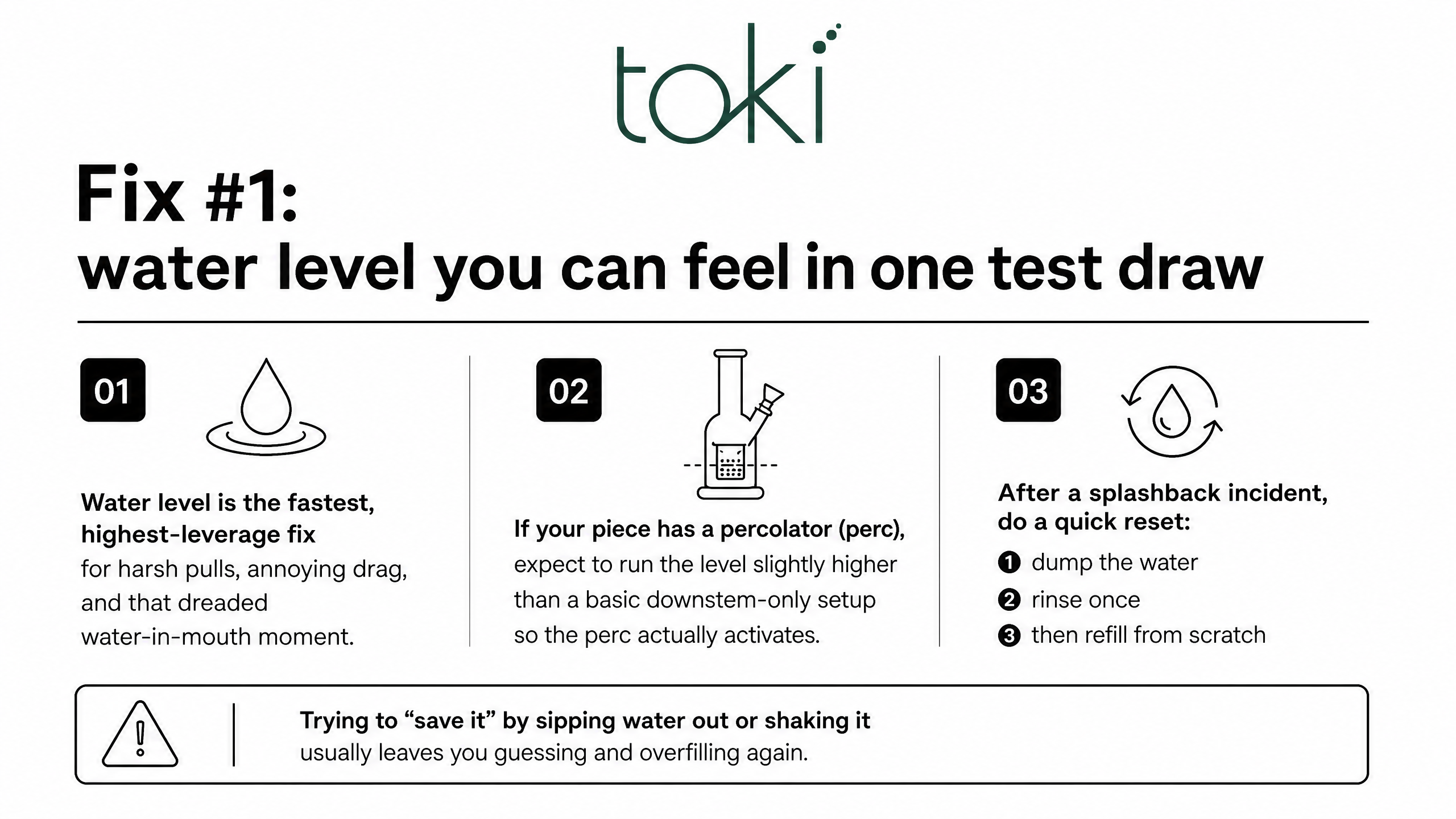
Water level is the fastest, highest-leverage fix for harsh pulls, annoying drag, and that dreaded water-in-mouth moment. If your piece has a percolator (perc), expect to run the level slightly higher than a basic downstem-only setup so the perc actually activates.
After a splashback incident, do a quick reset: dump the water, rinse once, then refill from scratch. Trying to “save it” by sipping water out or shaking it usually leaves you guessing and overfilling again.
Aim for 1-2 inches above
Your baseline target is simple: fill until the end of the downstem sits about 1-2 inches under water. That gives you diffusion without turning the pull into a workout.
You’re aiming for a steady bubble stream, not loud chugging. When the downstem is too deep, the water has more pressure to push through, so you feel extra resistance and you can kick up more splash.
Splashback usually shows up right after you cross the “too high” threshold, especially on shorter pieces or wide-open downstems. If you take one dry pull and your lips immediately feel misty or you taste water, you’re past your personal limit.
- Too low: weak bubbling, harsher feel, less cooling
- Dialed: consistent bubbles, smooth pull, no water climbing the neck
- Too high: chuggy resistance, water creeping up, higher splashback risk
Test draw before you light
Do one test draw before you light anything. This dry pull tells you, instantly, whether the water level is giving you smooth airflow or fighting you.
Check two things at once: resistance (does it feel tight and chuggy?) and splash (do you feel water moving toward your mouth?). That one pull is your repeatable test, and it beats guessing based on what the chamber looks like.
Adjust in small pours only. Add a little water, test again, and stop as soon as the bubbles get consistent without sending water up the neck.
Match the level to how you actually use the piece. If you naturally tilt your bong when you draw, fill with that tilt in mind, because the waterline shifts and can push you from “dialed” to “splashy” fast.
- Too much drag: pour out a small amount, then re-test
- Not enough bubbling: add a small splash of water, then re-test
- Splashback: lower the level and re-test with your usual tilt angle
Fix #2: clean the diffusion path so smoke can cool
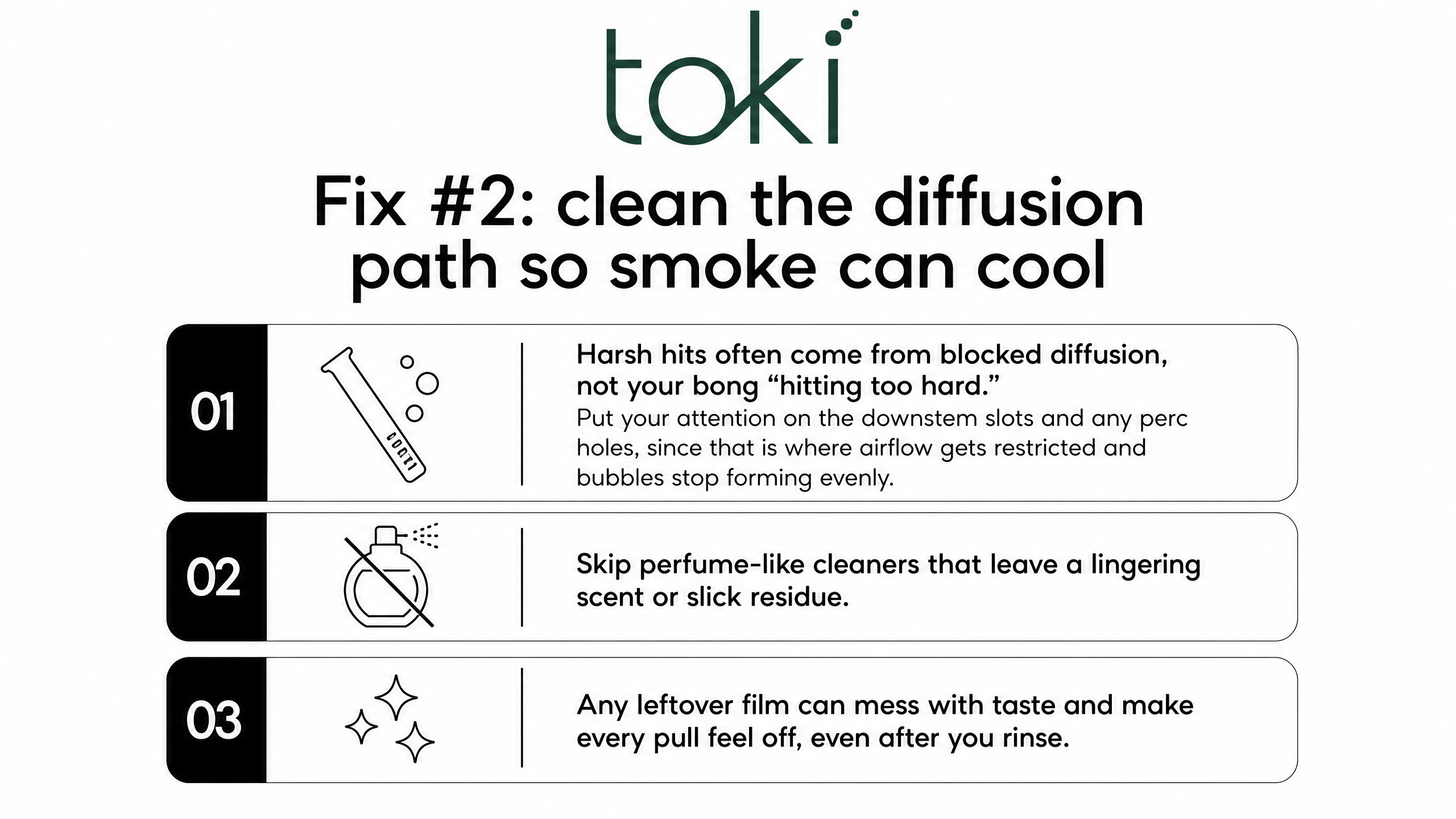
Harsh hits often come from blocked diffusion, not your bong “hitting too hard.” Put your attention on the downstem slots and any perc holes, since that is where airflow gets restricted and bubbles stop forming evenly.
Skip perfume-like cleaners that leave a lingering scent or slick residue. Any leftover film can mess with taste and make every pull feel off, even after you rinse.
Downstem and perc choke points
Resin buildup is the most common choke point we see, and it narrows airflow fast. Once the downstem slots or perc holes start to glaze over, you end up pulling harder to get the same chamber fill.
That restriction changes diffusion. Instead of lots of small bubbles (more surface area, more cooling), you get fewer, bigger bubbles that feel hotter and harsher because the smoke spends less time breaking up in the water.
Watch your bubbling for quick diagnostics. When diffusion is working, bubbling looks even and consistent across the downstem and perc; when it is dirty, you will see dead zones and “random” chugging.
- Resin-narrowed airflow: you feel more drag even with the same water level and packing
- Bigger bubbles: the water surface looks like it is “burping” instead of fizzing steadily
- Inconsistent bubbling: one side of a perc fires while another stays quiet, or it pulses on and off during the pull
When bubbling smooths out again, you usually notice the biggest drop in harshness without changing anything else about your setup.
A weekly routine that sticks
Consistency comes from a routine you can actually keep. You do not need a complicated soak every time, but you do need to stop residue from getting a week-long head start in the stem and perc.
Right after a session, a quick hot-water rinse helps keep the stem slots and perc holes open. Then commit to one weekly deep clean so you are not chasing mystery harshness.
Fresh water every session matters more than people think. Old water gets funky, and even a clean perc cannot diffuse well in water that is loaded with debris.
- After sessions: empty the water chamber, rinse with hot water until it runs clear, and let it air-dry
- Weekly deep clean: remove the downstem and bowl, clean until the slots and holes are fully open again, then rinse thoroughly until there is no scent left behind
- Every session: refill with fresh water before you light up, not “later”
If your downstem is permanently gunked or the fit is sloppy, swapping to the Toki 2.0 Universal Downstem is a simple way to get clean, predictable diffusion back without buying a whole new piece.
Fix #3: pack and pull like you want less cough
Your bowl and your flame control decide how hot and sharp the hit feels. A basic Bic-style lighter works, but the real upgrade is consistency: a steady flame you can aim, not a raging torch that scorches one spot and spikes the chamber temperature.
If your throat is sensitive, go smaller on the bowl. Smaller loads are easier to manage, less likely to overheat, and they keep you from powering through a half-charred bowl just because it is packed.
Pack for airflow, not density
Most harsh hits start with a bowl that is packed too tight. You want air to move through the material evenly, so combustion stays controlled instead of tunneling and flaring.
Use a light, even tamp. Think “level and springy,” not “compressed.” When airflow is right, you get a cleaner pull, and the bowl burns at a steadier pace instead of overheating at the top.
Light the edge, not the whole surface. Edge ignition lets you “walk” the cherry around the rim and take smaller, cooler sips while keeping flavor and heat under control.
Mid-bowl ash is a hidden cough trigger because it blocks airflow and forces you to pull harder. When the top turns to a thick ash cap, gently tap it out, or use a poker to break it up so fresh air can pass through again.
- Tamp standard: level the top and press just until it holds shape, then stop
- Edge-light: aim the flame at the rim and rotate the bowl as the cherry forms
- Ash management: clear the loose top ash before it mats down and chokes the bowl
Slow draw, fast clear
A steady inhale is your built-in temperature control. Pulling hard makes the bowl burn hotter and loads the chamber fast, which is where the “hot and scratchy” feeling comes from.
Take a smooth, even draw to keep the burn stable, then do a quick “snap and clear.” That means you stop feeding the bowl, remove the bowl piece (or uncover the carb hole), and clear the chamber in one clean pull before the smoke sits and turns stale.
Timing matters more than lung power. If you feel the tickle turning into throat burn, do not hero it. Stop, clear what is in the tube, and reset with a smaller, cooler pull on the next one.
- Inhale pace: slow and consistent, like sipping through a thick straw
- Clear timing: clear right after your hit, not after the chamber gets dense and harsh
- Hard stop rule: the moment you feel throat burn building, end the hit and reset
Fix #4: cooling options that change the feel fast
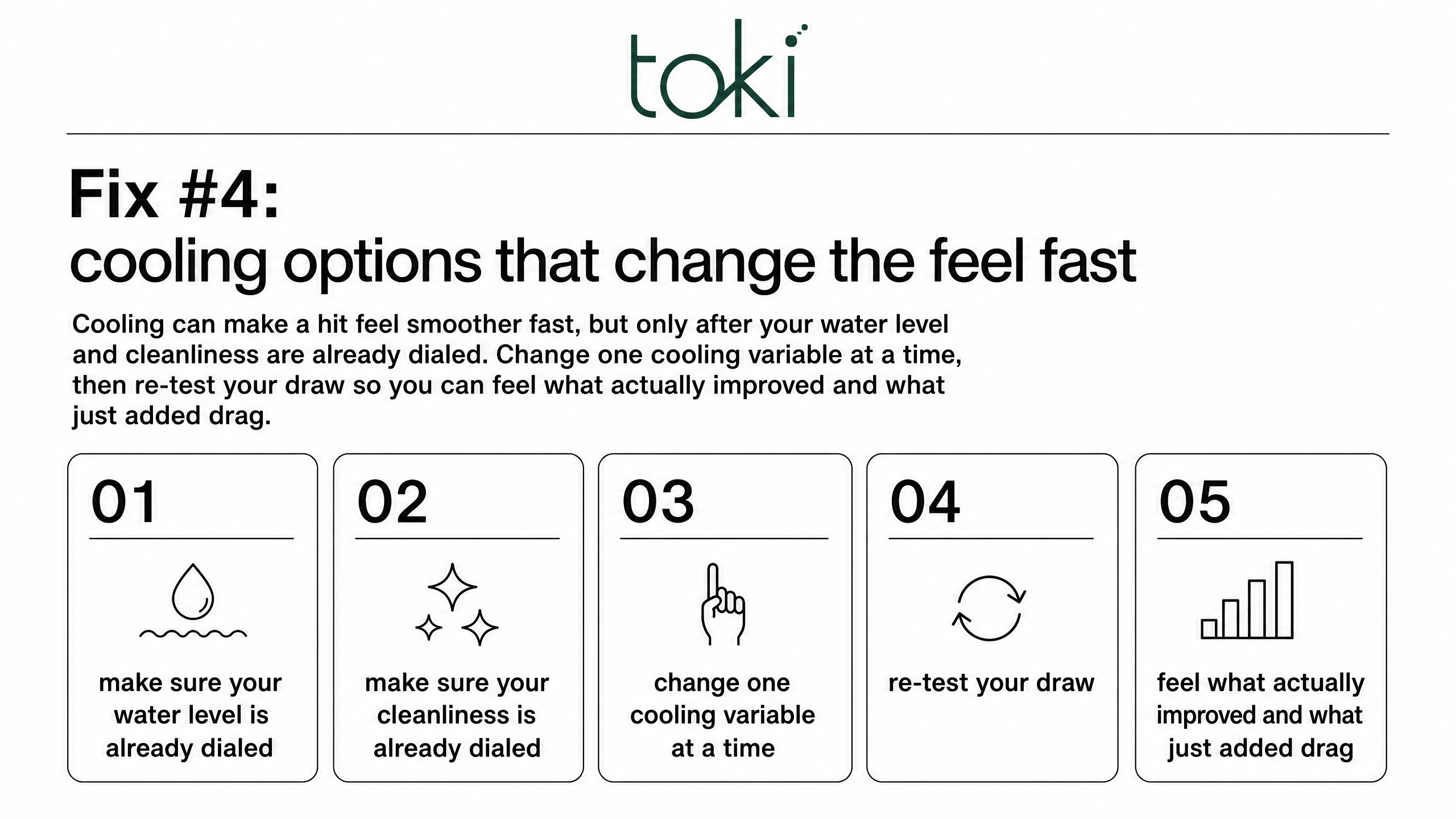
Cooling can make a hit feel smoother fast, but only after your water level and cleanliness are already dialed. Change one cooling variable at a time, then re-test your draw so you can feel what actually improved and what just added drag.
Use an ice pinch correctly
Ice helps most when it chills the smoke path without messing with your water setup. The goal is colder air flow, not a jammed tube or a splashy mess.
Keep ice sitting in the ice pinch area so it stays above the waterline. When cubes drop into the water chamber, you get extra meltwater, shifting water level mid-session and changing the pull you just tuned.
Over-icing is the common mistake we see. Too many cubes crowd the neck, reduce airflow, and create that “straw” feel that makes you pull harder than you planned.
Swap ice, do not top it off. After a bit, cubes get rounded and wet, and they tend to stick or slide; fresh cubes hold position better and cool more consistently.
- Use 2-4 medium cubes, spaced so air can move around them
- Stop adding ice if you notice new drag or gurgle
- Dump meltwater and reset to your normal water level before the next round
Cold water versus room temp
Cold water usually feels smoother on your throat, but it is not automatically the right move for every session. Room temp water often keeps airflow more consistent and cleanup easier.
Cold water can increase condensation on the glass, especially in a cooler room. Expect a wet exterior, a slippery base, and more wiping down around your session spot.
Session length matters. Cold water warms up pretty quickly once you are taking repeated pulls, so the “first few hits” can feel different from the later ones. Room temp water stays steadier across longer sessions, while cold water is a quick comfort play for short rounds.
- Short session: cold water for immediate comfort and a cooler-feeling pull
- Longer session: room temp for consistency and less condensation hassle
- Any change: take two test pulls before lighting up to confirm the draw still feels right
When setup is dialed: the bong features that keep hits smooth
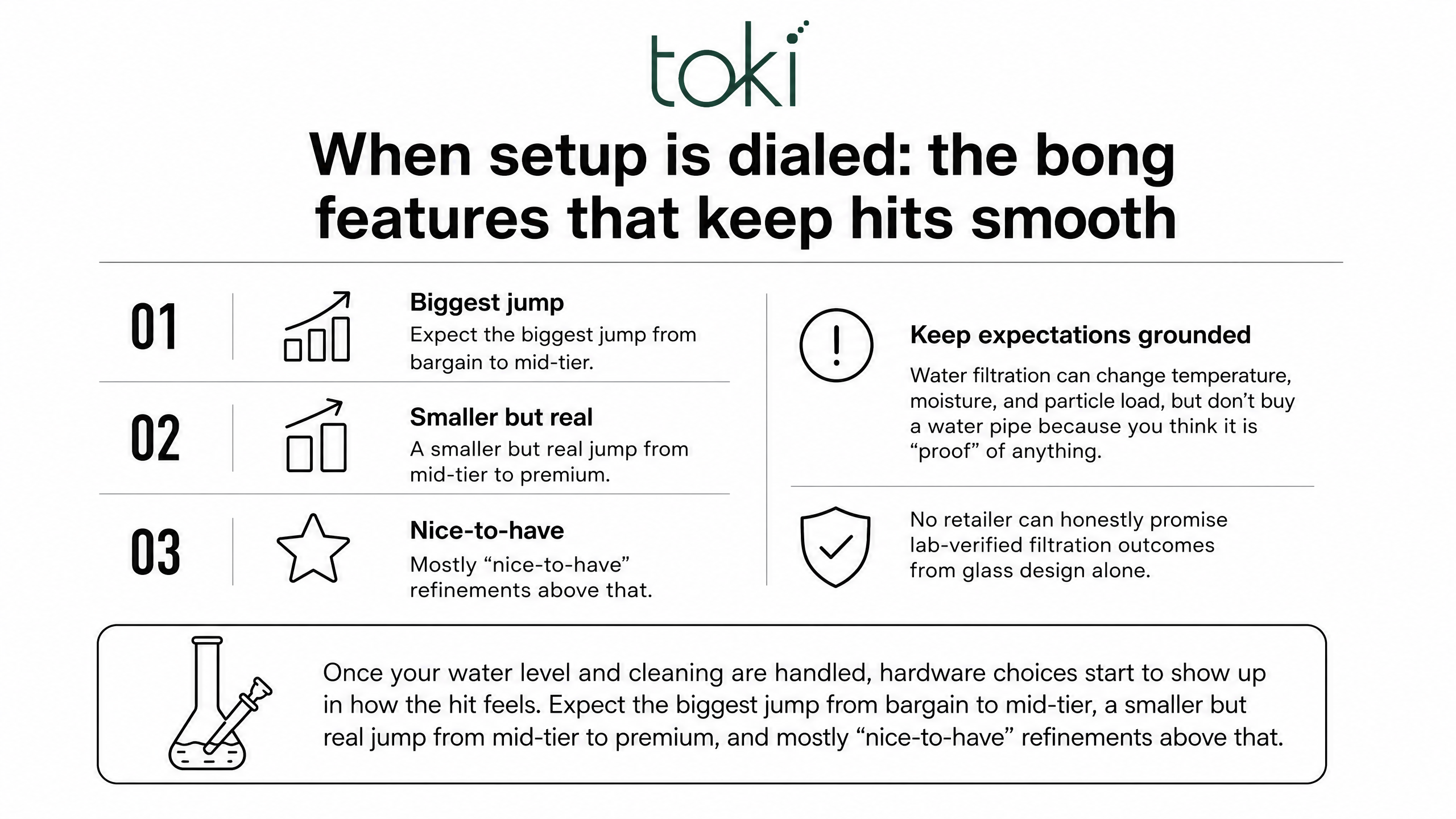
Once your water level and cleaning are handled, hardware choices start to show up in how the hit feels. Expect the biggest jump from bargain to mid-tier, a smaller but real jump from mid-tier to premium, and mostly “nice-to-have” refinements above that.
Also keep your expectations grounded: water filtration can change temperature, moisture, and particle load, but don’t buy a water pipe because you think it is “proof” of anything. No retailer can honestly promise lab-verified filtration outcomes from glass design alone.
Beaker versus straight-tube feel
Choose beaker versus straight-tube based on the feel you want, not the label. A beaker base gives you more water volume and a wider footprint, while a straight tube is all about a direct pull and fast clearing.
With a beaker bong, that extra base volume usually feels a bit more forgiving. The piece sits planted on a table, and the water has more room to move, which can take the edge off when you pull a little harder than planned or you are passing it around.
A straight-tube bong typically clears quicker because the chamber is simpler and the airflow path is more direct. You get less “hang time” in the tube, so the hit can feel punchier and more immediate, with less lingering stale smoke if you are good at clearing cleanly.
- Upgrade for stability and shared sessions: beaker style, wider base, harder to tip, more water volume
- Upgrade for quick clears and simple feel: straight tube, direct draw, less chamber volume to clear
- If you hate water in your mouth: straight tubes are more sensitive to overfilling, while beakers often tolerate a slightly higher fill before you get splashback
Diffusion versus cleaning reality
Diffusion is where “smooth” usually comes from, but every extra surface that breaks bubbles also collects residue. The right call is the most diffusion you will actually keep clean, with a pull that still feels natural day to day.
A showerhead perc is a sweet-spot design for a lot of people because it adds noticeable bubble breakup without turning your water pipe into a chore. You get more diffusion than a basic downstem setup, but it is still straightforward to rinse and scrub compared to complex multi-perc stacks.
More percs can feel cooler and softer, but cleanup time climbs fast. If you know you already procrastinate on maintenance, a simpler perc (or even a clean, diffused downstem) often stays smoother over the long run because it stays cleaner.
Watch for drag, too. Too much diffusion can make the pull feel restricted, which tempts you to yank harder and that can flip “smooth” right back into harsh. If you want a clean, balanced daily driver, the Glass Lab 303 12.5 Inch Straight Tube Fumed Water Bong is a solid example of keeping it simple with a showerhead perc and easy clearing.
- Choose showerhead perc when you want smoother pulls without high-maintenance internals
- Skip multi-perc complexity if you will not clean often, because resin buildup kills diffusion and flavor fast
- Avoid high-drag designs for daily use if you catch yourself pulling harder just to get the chamber to fill
Three SmokeToki upgrades that solve specific smoothness problems
If you already fixed water level, cleaning, and pull speed, but the hit still feels rough, an upgrade can actually make sense. Just remember checkout is age-gated, and you get free discreet shipping on orders $50+.
If you want colder hits
When the issue is heat, not drag, you want built-in cooling. The Uber GOG 15 Inch Ice Pinch Beaker with Swirls is the straightforward pick because it gives you real temperature control without DIY add-ons.
An ice pinch is the clean solution here. You drop ice in the neck, it stays put, and you get a noticeably cooler inhale without awkward “how do I keep ice from sliding” hacks or improvised screens.
The beaker base also matters for day-to-day use. It sits steady on a table, handles regular sessions without feeling tippy, and it is the kind of piece you can keep out and actually use, not baby.
- Get this when: your hits feel hot even after you slowed your pull and dialed water level
- Why it solves it: ice pinch cooling is built into the tube, so the setup stays simple
- Why it reduces buyer regret: stable beaker format makes it a reliable daily driver, not a fragile “sometimes” piece
If you want easy clearing
If your problem is stale, lingering smoke in the chamber, you want a piece that clears fast and responds instantly. The Glass Lab 303 12.5 Inch Straight Tube Fumed Water Bong is built for that direct, responsive pull.
Straight-tube designs tend to feel more “point and shoot” than beakers. You pull, it fills, you lift the bowl, and it clears quickly without fighting the piece.
You still get real diffusion thanks to the showerhead perc, but the layout stays simpler to maintain than more complex multi-perc setups. That combination is what keeps the pull smooth without turning cleaning into a weekly project you avoid.
- Choose it over a beaker when: you care more about quick clearing than maximum base stability
- What you are buying for: straight-tube responsiveness plus showerhead diffusion
- Why it stays practical: simpler internals mean fewer hard-to-reach spots during cleaning
If you want consistency
When your session quality swings from “nice” to “why is this harsh today,” consistency usually comes from premium build and stability. The GRAV Empress Water Bong is the upgrade for that, especially if you are tired of babying thin glass.
The extra-thick construction gives you a more solid, planted feel. In our experience, that translates to fewer annoying variables in real use: less wobble on the surface you set it on, and less of that fragile feeling that makes you handle the piece differently every time.
If you want the same smooth feel session after session, this is the buy-once option in the lineup. Shop the GRAV Empress Water Bong on SmokeToki when you are ready to stop experimenting and just lock in a repeatable experience.
- Pick this when: you want a premium, stable piece that feels the same every session
- What you are paying for: thickness, weight, and overall build consistency
- Trade-off: it is a higher spend than the mid-range options, but you are buying durability and repeatability
Dial it in now, then upgrade only if you need to Run the checklist again on your current bong today. Set your water level to about 1 to 2 inches above the downstem, take one test draw, then clean the downstem and perc so diffusion can actually do its job. Small tweaks fix most harsh, hot pulls fast.
If you are still chasing colder, smoother hits, we have two clean upgrade paths at SmokeToki. Start with the Uber GOG 15 Inch (50x7mm) Ice Pinch Beaker with Swirls for cooler sessions with an ice pinch. If you want premium consistency and extra-thick glass, step up to the GRAV Empress Water Bong.
Shop SmokeToki, add your pick to cart, and check out with free discreet shipping on orders $50+. Age-restricted products, 21+ only.


